

Electronics
Blending MRWAIN model railway with electronics.
Electronics elevate model railways beyond static displays, providing the power, precision, realism, and automation that makes the hobby so engaging and satisfying.


Computers, Electronics and 3D Printers
Computers, electronics, and 3D printers have revolutionized the world of model railways, moving it far beyond simple DC control and static layouts. Their combined contributions have significantly enhanced realism, opertional complexity, customization, and accessibility.
 Computers: Computer software (like TrainController which is my personal choice) allows for incredibly sophisticated control.
 3D Printing: Computers facilitate the use of 3D printing to create custom parts and accessories, allowing for greater personalization and creativity in model railway layouts. 3D printing has allowed the creation of custom parts.
 Electronics: Electronics play a critical role in modern model railways, enhancing realism, control, and functionality.
Computers: Computer software (like TrainController which is my personal choice) allows for incredibly sophisticated control.3D Printing: Computers facilitate the use of 3D printing to create custom parts and accessories, allowing for greater personalization and creativity in model railway layouts. 3D printing has allowed the creation of custom parts.Modelers can design and print virtually any component, from unique rolling stock and locomotive shells to intricate details, buildings, scenery elements, and even custom track sections. This allows for unparalleled personalization and accuracy.
My gantry crane is a perfect example of what can be created by the use of a 3D printer.
Now think about this, you don't actually build a 3D model, you print it. A normal printer places ink on a piece of paper, where as a 3D printer places
the material (ABS) onto the build table. Tell me what the difference is?
Electronics: Electronics play a critical role in modern model railways, enhancing realism, control, and functionality. DCC Systems are a perfect example of electronics in use, along with stationary and mobile decoders, lighting effects and signal control...the list goes on.
In summary, the interaction between computers, electronics, and 3D printers has transformed model railways from a largely mechanical hobby (remember wind-up locomotives) into a sophisticated blend of engineering, artistry, and digital control. They enable greater realism, complex operations, and unparalleled customization, making the hobby more accessible and engaging for a wider audience.

Speedometer: Another useful purpose for it.
"TrainSpeed1" is designed to measure the scale speed of locomotives or train cars that past by it. Light sensors mounted discretely between the ties are used to record the speed of anything passing over them and then the device calculates and displays the corresponding scale speed on the display.
I never used it for speed monitoring simply because the speed of a train never interested me at all.
I used it for speed matching.
Speed matching locomotives on a model railway ensures that multiple locomotives operate at the same speed when coupled together, particularly in multi-unit consists like those used in DCC (Digital Command Control) systems.
To achieve this, you adjust the locomotives' speed curves, start voltages, and acceleration/deceleration settings (often via Configuration Variables, in DCC decoders) to align their performance across a range of throttle settings. This process is critical for consists where locomotives of different brands, ages, or motor types are used together.
It prevented mechanical stress within the locomotives, ensured smoother operation and ensuring balanced power distribution throughout the consist.
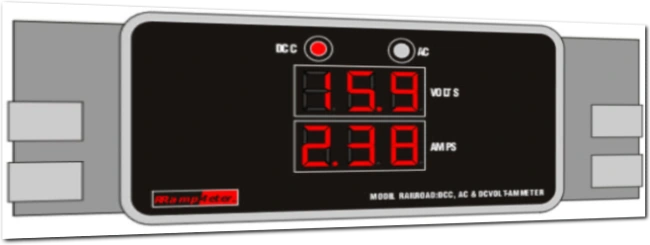
RRampmeter
The only inexpensive device that accurately measures DCC Volts/Amps.
Also measures AC and DC Volts/Amps.
Costs less than DVMs that cannot measure DCC.
Ver I, II, & III rated at 10 Amps and Ver IV rated at 20 Amps.
Measures true RMS Volts/Amps, +/- 2%.
Suitable for all scales.
No batteries required.
Designed for Left/Right-hand use
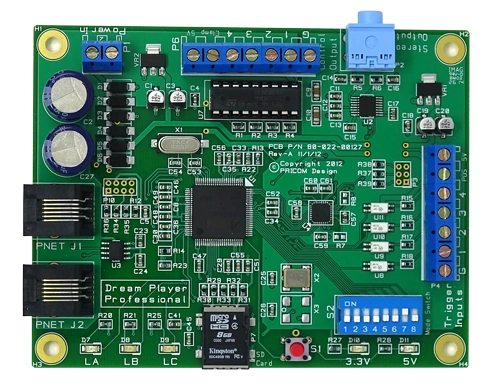
Solid-State WAV file Audio Player adds Sounds to your project! Use up to 4 Trigger inputs and control 4 outputs. Many Sound Scene files available by Free Download from the Pricom website! Have you ever wanted to expand past onboard sound? Sure a decoder inside a loco adds realism to your loco, but what about the rest of the layout? Birds singing, dogs barking, a sawmill running, men working in the shed, how about a logging operation?

1. Railway-crossing-bell
00:00
Electronics for Model Railways
Came across this document on the internet.
Each chapter (29 of them) are separate pdf's. I downloaded and combined all into one pdf.
The author has indicated the book(s) may be freely copied and distributed so here it is.
The file is large, 98 megabytes, so please take the size into consideration if you are going to download it.
This is one of the best books I have come across.
Well written with all the information you will ever need about model railway electronics.